Connection statistics
Live statistics for a Fluid session, updated every second. Use them to find out why a session is slow or blurry, for example because of packet loss or blocked UDP. Red values point to a problem.
Show statistics
| Client | Steps |
|---|---|
| Windows, macOS | Choose Help > Show Fluid Connection Stats. |
| iPhone, iPad, Android | In the session toolbar, tap the wrench button, then Show Connection Stats. |
| Web browser | Open the settings drawer and turn on Show Stats. See Connect from a web browser. |
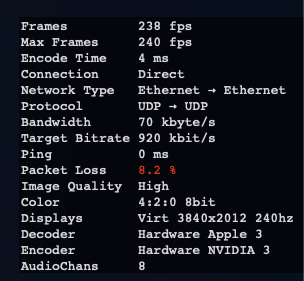
Statistics
"Host" is the remote computer. "Local" is the device you connect from. Menu names are from Windows, macOS, iPhone, and iPad. On Android, the menus are Frame Rate, Max Bandwidth, Codec, and Color Quality. The web browser has only Frame Rate and Maximum Bandwidth.
| Statistic | Shows | What to look for |
|---|---|---|
| Frames | Frames the host encoded in the last second. | 0 usually means the remote screen didn't change. Frames can also be skipped when video exceeds the bandwidth allowed. |
| Max Frames | Most frames per second the host will send. Set with the Framerate menu. | |
| Encode Time | Milliseconds the host takes to encode a frame. | High values mean heavy host load. Measure with something moving on screen, such as a video; readings vary at low frame rates and with hardware encoders. |
| Connection | Direct (no NAT between the devices, such as the same network or a VPN), Direct NAT (peer-to-peer across the internet), or Relay (through a relay server, when no direct path works or a team administrator requires relay connections). | |
| Network Type | Network in use, such as Ethernet, Wifi, Cellular, or VPN. With an arrow, the local side comes first. | |
| Protocol | UDP, TCP, Relay UDP, Relay TCP, or Relay TCP-TLS. With an arrow, the local side comes first. | UDP generally performs best. |
| Bandwidth | Video data received in the last second, in kbyte/s. | |
| Target Bitrate | The bitrate the host is currently aiming for, in kbit/s. It changes with network conditions, up to the Maximum Bandwidth menu or Connect settings. | Well below Maximum Bandwidth means the network can't carry more right now, or a team administrator's Maximum Target Bandwidth is lower. With packet loss, try a lower maximum. |
| Ping | Network latency between host and local, in ms. | Red: ping is unsteady (jitter). |
| Packet Loss | Percentage of packets lost in the last second. | Red whenever loss is detected. Jump Desktop compensates, which can lower image quality or responsiveness. |
| Image Quality | Very High, High, Medium, or Low. | Lower values can mean network problems or packet loss. |
| Color | Chroma format and bit depth, such as 4:2:0 8bit or 4:4:4 10bit. 4:4:4 gives sharper text and exact colors; 10bit gives more colors. Set with the Color menu (Color Quality on iPhone, iPad, and Android). | |
| Displays | Resolution and refresh rate of each remote display. Virt marks a virtual display created by Jump Desktop. | |
| Decoder | Decoder on the local device: Fluid, Fluid 2.0, or Hardware with a GPU vendor (Apple, NVIDIA, AMD, Intel). | |
| Encoder | Encoder on the host, using the same names. Hardware encoders reduce host CPU load. Set with the Codec menu. | |
| AudioChans | Remote audio channels: 1 mono, 2 stereo, 6 for 5.1, 8 for 7.1. Blank when no audio is streaming. |
Client differences:
- Android: no Color or AudioChans. Connection shows Direct (P2P) or Relay. Adds Decode Time, the milliseconds this device takes to decode a frame.
- Web browser: no Protocol, Color, or Displays.
Related
- Slow or laggy sessions: symptoms, what the numbers mean together, and what to try.
- Codecs and hardware encoding: choose a codec and color level.