Cloudless Fluid
Connect to a computer's hostname or IP address over Fluid, with no Jump cloud service in the path. Because connections don't go through Jump's cloud, it works for computers without internet access. Use it on isolated or high-security networks, for example computers reached only over your VPN. For other options, see Choose a connectivity option.
Applies to
- Jump Desktop for Teams Enterprise plan.
- Team administrators turn it on. End users connect.
- Remote computers running Jump Desktop Connect on Windows, macOS, or Linux (beta).
- Jump Desktop on Windows, macOS, iPhone, or iPad, signed in to a Teams Enterprise account. Otherwise the app refuses Cloudless Fluid connections, including from launch URLs.
- Jump Desktop for Android and the web browser client can't make Cloudless Fluid connections.
Before you start
Warning
Access Groups and other team access controls don't apply to Cloudless Fluid. Anyone who can reach the computer's port and knows a local username and password can sign in. Protect the computer with your firewall or VPN, and consider restricting access by user or group.
Allow this traffic from clients to the remote computer:
| Protocol | Port | Purpose |
|---|---|---|
| TCP | Manual Fluid Port (default 35384) | Incoming connections |
| UDP, with TCP as fallback | Connection Port Range: 35385-35485 by default on computers with a Connect Configuration; 35385-45385 on computers without one. See Network requirements. | Session traffic |
Turn on Cloudless Fluid
Do this for each remote computer, using either method.
From the Teams dashboard: in a Connect Configuration, select Manual Fluid Connections. Optionally change Manual Fluid Port. Assign the configuration to the computers.

On the computer (Windows or macOS, for example when it has no internet access):
- Open Jump Desktop Connect and go to Settings > Advanced.
- Make sure Fluid Remote Desktop is turned on.
-
Select Manual Connections (requires Teams subscription). Optionally change Port.
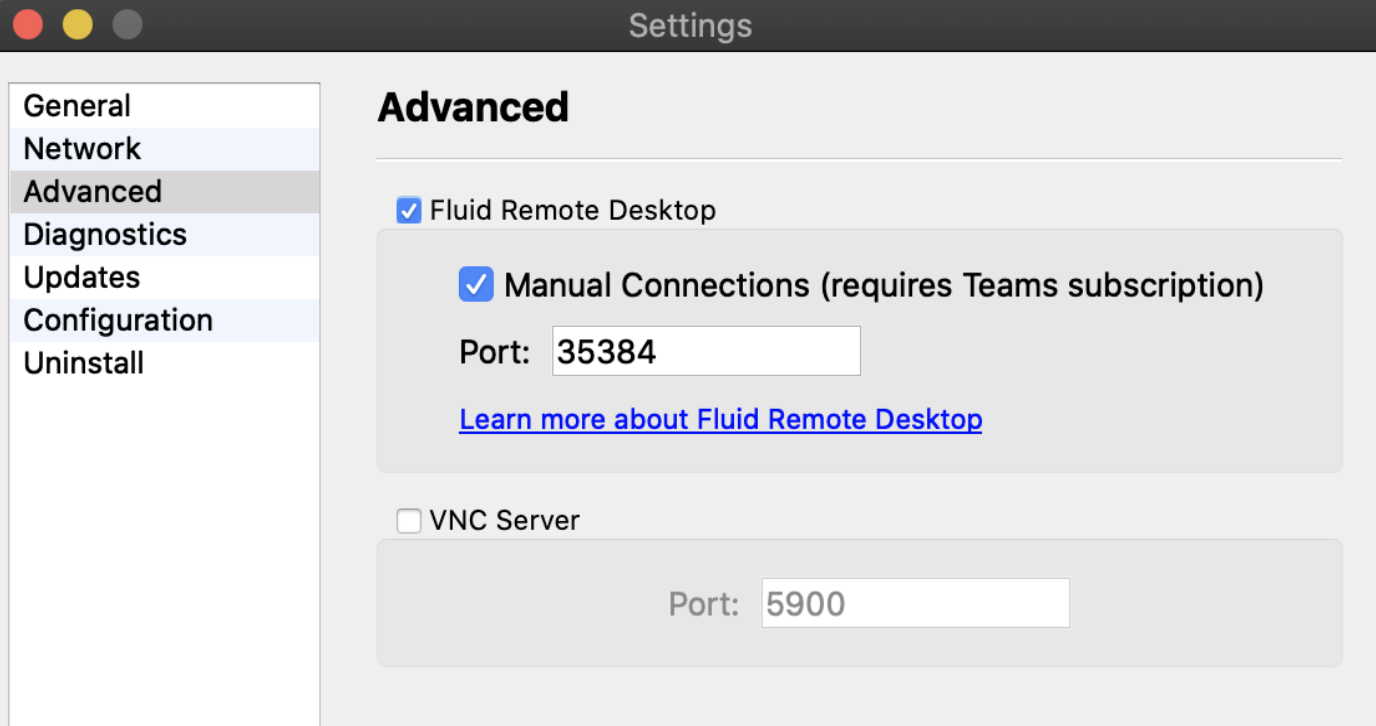
The option is greyed out unless Fluid Remote Desktop is on and local changes are allowed. On a computer with a Connect Configuration, local changes require Local Configuration Changes in that configuration.
Connect
Launch URL: on the remote computer, in Settings > Advanced, click Copy Launch URL. If users reach the computer by another name or IP address, edit the host name in the URL. Send it to users. The URL pins the computer's fingerprint, so Jump Desktop refuses a mismatched computer. See Launch links and connection files.
Add by hand (Windows and macOS):
- In Jump Desktop, click File > Add New....
- For Type, choose Fluid.
- Enter the Host as a hostname or IP address. Add
:portif the computer doesn't use 35384. - Enter a Name and add the computer.
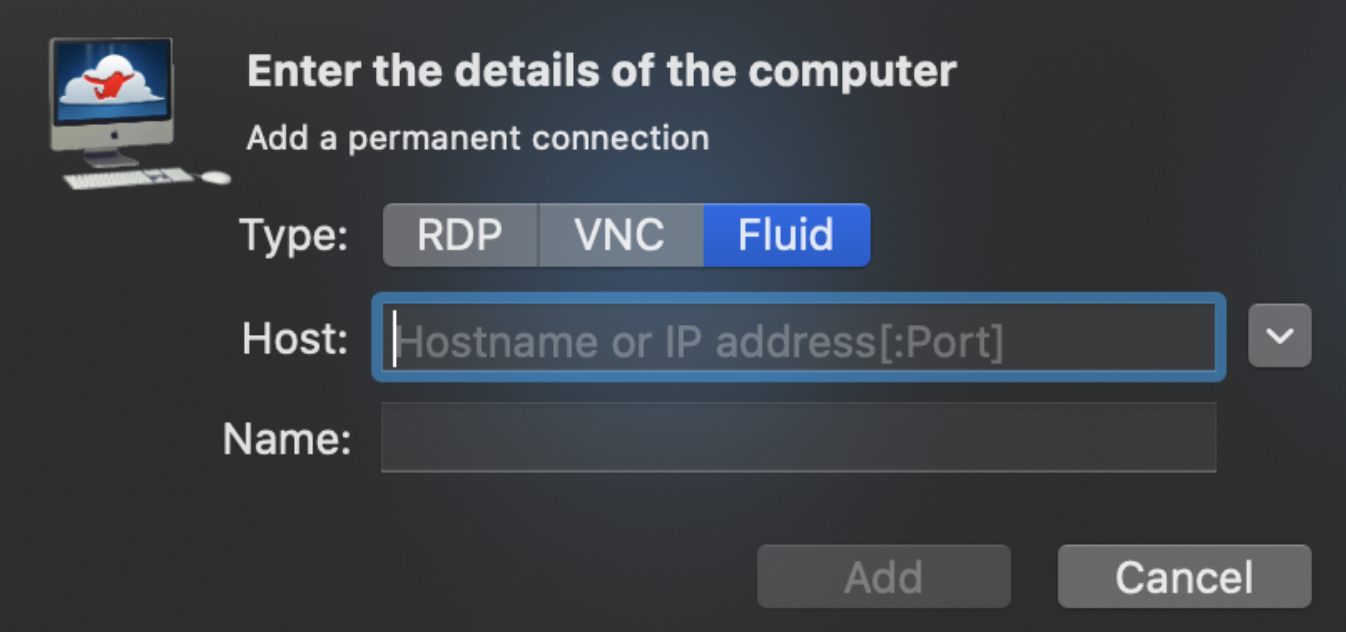
Add by hand (iPhone and iPad): in the computer list, tap +, set Type to Fluid, and enter the Host and Port (default 35384).
Verify the fingerprint
The first time you connect to a computer you added by hand, Jump Desktop shows Verify Fingerprint. Compare it with View Fingerprint in Connect's Settings > Advanced on the remote computer. Click Trust and Continue only if they match.
If the fingerprint changes later, click Reject (Recommended) unless you expected the change.
Then sign in with a local user account on the remote computer.
Restrict access by user or group
By default, any local user who signs in successfully can connect. On Windows, the user must also be in the Administrators or Users group.
To allow only specific users or groups (Connect 10.5 or later):
- Edit a Connect Configuration and select Beta to show beta settings.
- Under Fluid Settings, next to Local Authentication Restrictions, click Configure.
- Select Restrict to allowed users and groups.
- Add names under Users and Groups as they appear on the computer. Click Save.
- Save the Connect Configuration.
Restrictions apply only to computers that have the configuration assigned. A user who matches either list can connect; everyone else is denied.
Warning
If restrictions are on and both lists are empty, no one can connect.
| Platform | Users | Groups |
|---|---|---|
| Windows | alice or DOMAIN\alice |
Remote Desktop Users |
| macOS | Short username, such as alice |
admin, staff |
| Linux | Local username, such as alice |
sudo, wheel |